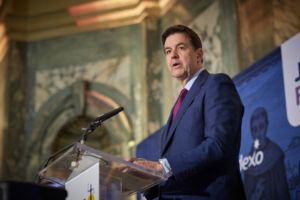
Sir Edward Braham’s Keynote Address
Justice for Victims & Survivors
23rd March 2026
It is a privilege to be here tonight, among such a well informed audience.
Many of us came to modern slavery the same way, by being sickened about what is happening and the realisation that it is all around us. I also come at this with my experiences as a businessman and former corporate lawyer, and I am someone who looks for root causes and lasting solutions.
I am going to outline what we mean by modern slavery; touch on the challenges in dealing with it; and explain why the Global Commission was established, what it has done, and what it is seeking to do. I will then explore how we might clean up supply chains, touch on some interventions that give me hope and finish with some concluding thoughts.
WHAT IS MODERN SLAVERY?
When we talk about modern slavery, we mean the exploitation of labour, of freedom and autonomy, and of vulnerability — from forced labour and debt bondage to sexual exploitation, forced marriage, domestic servitude, and the abuse of children, including child soldiers. Modern slavery is global but not distant — it exists all around us, often hiding in plain sight.
It can be people working on construction sites, people caring for our elderly relatives in care homes, people working in nail bars, people washing dishes in our favourite restaurant, and people working in private homes across the country. And because modern slavery operates in global supply chains, it can also be found in the clothes we wear, the mobile phones we rely on, and the food and drink we consume.
Vulnerability drives exploitation, and vulnerabilities come in many forms – such as homelessness, financial desperation, insecure immigration status, and other forms of structural vulnerability. Trafficking amplifies vulnerability. And vulnerability is increasing — driven by armed conflict, inequality, climate change, and weak protections.
The defining feature is the exploitation of vulnerability where systems fail to protect, not the form of exploitation.
A DEFINING CHALLENGE OF OUR TIME
The UK’s Modern Slavery Act of 2015 was pioneering. It strengthened offences, increased sentences, improved victim protections, and required large companies to report on what they were doing in their supply chains. And yet today, an estimated 130,000 people are living in conditions of modern slavery in this country. That is roughly the adult population of two parliamentary constituencies — living in slavery in the UK today. Globally, the figure is estimated to exceed 50 million, probably by quite a lot.
The technical and practical legal issues are complex, such as the CPS decision on whether and what to prosecute, availability of the partial defence of section 45 and the common law defence of duress; persuading vulnerable victims to engage with the authorities; and the difficulty of getting vulnerable victims to give reliable evidence.
The result is a justice gap, in which complexity, fragile evidence, and victim vulnerability combine, to the advantage of perpetrators.
THE GLOBAL COMMISSION ON MODERN SLAVERY AND HUMAN TRAFFICKING
The paradox is this. At precisely the moment when the problem is growing, efforts to end modern slavery have lost momentum. Politically — and I mean that with a small “p” — the issue has slipped down the agenda. And at the same time the debate is being distracted by popularist sentiment, by the conflation of illegal migration and trafficking, and by the geopolitical tensions that demand our attention.
But it should not be an either/or. As one economist put it to me recently — we simply are not talking about it enough. When I think about it that way, we can make some progress.
Indeed, that is why the Global Commission was established. To push global momentum. And to drive action towards eradication. We bring together political leaders, civil society, business, researchers — and, critically, people with lived experience. I say “critically” because I have seen first hand the insights that people who have experienced these crimes bring, and the importance of those perspectives on any effective policy intervention.
THE COMMISSION‘S WORK
Last year, we published our report, “No Country is Immune,” alongside a Prevention Framework. The core insight was simple: modern slavery does not begin randomly. It thrives where instability, inequality, and weak protections intersect. And policy that focuses on prevention — not just response — works better.
If you haven’t seen them, please do look on the website at both the Commission’s report and the Prevention Framework.
So what is the Commission doing? We focus on three things: persuading businesses to tackle forced labour in their supply chains; helping countries turn international commitments into effective domestic law; and working on integrating anti‑trafficking efforts into humanitarian responses — because trafficking thrives in crises, and trafficking amplifies vulnerability.
How do we actually do that? Again, three things: we provide international leadership; we build the evidence base; and we set up collaborations that would not otherwise happen.
Tonight, I want to focus on supply chains and some interventions that give me hope.
ACTION ON SUPPLY CHAINS
I’ve chosen supply chains partly because we are in this world-famous Court in the City of London, so the relationship between law and economics feels an appropriate topic; and partly because it is an area where everyone in the room can have influence.
No country is immune
Businesses need supply chains to function and they are often long and complex. If you think of a product moving from source to final use, the chain as a whole is contaminated if exploitation exists at any point along that chain. And if the product is used to deliver a service, that service is contaminated.
There are any number of high risk industries around the world: agriculture, construction, manufacturing, cobalt mining, take your pick. But you may also remember the revelations from Leicester — where thousands of mostly migrant workers were paid far below the minimum wage to produce clothes for major brands. It had been happening for years, right under our noses.
These are not isolated abuses — they are symptoms of systemic, societal, vulnerabilities that require co-ordinated action.
At heart, this is about the practical limits on what the private sector can do alone, and what the public sector can do without the support of the private sector. The Modern Slavery Act introduced reporting requirements and other countries adopted similar approaches. But transparency alone has not been enough.
Transparency alone will never be enough
The Commission’s conclusion is simple; transparency alone never will be enough, and prevention must come before enforcement. Among other things, police time is finite, and if you are trapped in a modern slavery situation, slow justice will feel like no justice at all.
That is why we support a clear legal duty on companies to identify, prevent, and address forced labour risks. The key defence to such a duty would be to show that you had taken reasonable steps to prevent modern slavery. A core element of the defence would be due diligence.
So is mandatory human rights due diligence a miracle cure? No, of course not. We already impose similar duties to prevent bribery, corruption, and fraud — and those crimes persist. Critics are also right to say that due diligence can become a compliance exercise rather than a protective one. That is precisely why prevention, intelligence‑sharing, and enforcement design matter.
The objective should be changing behaviour before harm occurs. There are three achievable interventions that would make a profound difference: changing the narrative; sharing intelligence; and fighting trafficking like organised crime.
Changing the narrative
So starting with the narrative. Modern slavery is emotionally painful for us all. It is reputationally risky for anyone seen to be associated with it — whether or not they are guilty of misconduct. In that context, it is perhaps no surprise that virtually all modern slavery statements conclude that nothing has been found. Yet we all know that the business is highly unlikely to be immune from modern slavery.
If governments and NGOs want behaviour to change, their rhetoric must make clear that identifying and taking action on exploitation is to be commended. Or to say it in a different way, it is a sign of integrity to find and take action on modern slavery. But failing to do so could be a sign of indifference, or worse, complicity.
The best companies understand this, and are clear and robust in their communications and actions, and Governments already understand this logic in areas such as drugs enforcement, where success is measured by supply chain disruption, not by claims of immunity. Shifting attitudes will not be easy, but it is essential.
Sharing information
The second intervention is for Governments and international organisations such as Interpol to share information in the way that they do with money laundering and cyber crime. Those too are problems with no respect for borders. And in both cases there are longstanding and effective public-private partnerships that cover training, live information sharing, and co-ordinated enforcement.
Doing the same for modern slavery would turbocharge the impact of supply chain diligence. Encouragingly, there are experiments along these lines, one of which is in Thailand.
Fight trafficking like organised crime
The third line of attack is to fight trafficking like organised crime. More specifically, we need to task law‑enforcement teams who target drugs and guns also to look for trafficking.
These crimes operate along the same routes. And within the same networks. If you look for people as well as weapons and drugs, finding one will often lead you to the others. Organised‑crime approaches help because they allow prosecutors to rely less on traumatised witnesses, and more on financial, communications, and conspiracy evidence. There may also be an option to select among a wider range of charges with a view to minimising the risks associated with vulnerable witnesses, and thereby maximising conviction rates.
It is one of the few areas where widening the task increases the likelihood of success. Individually, each of those interventions would be impactful. In combination, changing the narrative, sharing information, and fighting trafficking like organise crime feels to me game changing.
PROMISING INTERVENTIONS
I said I would touch on some interventions that give me hope.
Bahrain — systems that are fast, visible, and trusted save lives
The first is Bahrain, which relies heavily on migrant labour, and like many countries has experienced serious exploitation. What matters is not that exploitation exists, but that the response focused deliberately on changing victim and employer behaviours, by changing system design.
Two interventions are worth noting: reforms to the visa system that allowed eligible workers to self‑sponsor, thereby reducing dependency on a single employer; and their Expatriate Protection Centre, that provides rapid access to advice, shelter, and coordination with embassies and civil society.
I have visited the Centre, where staff see around 150 people a day. In one case, a woman trapped in domestic forced labour contacted the Philippine authorities, who in turn alerted the Centre. Twenty‑one minutes later, the Bahraini authorities confirmed she had been located and was safe.
The lesson is that speed, accessibility, and credible protection fundamentally alter incentives. Victims come forward when they believe reporting will lead to immediate safety, rather than prolonged risk. Systems that are fast, visible, and trusted save lives.
Fair Work Agency
Moving on, the creation of the Fair Work Agency here in the UK presents a significant opportunity in the search for forced labour, provided it is fully integrated into the wider enforcement landscape.
The Agency will enter workplaces with statutory powers, and a remit that gives it routine access to sectors where exploitation is known to occur. That matters, because modern slavery is rarely uncovered through complaint alone. If those inspections are properly supported — through intelligence‑sharing, referral pathways, and coordination with other enforcement bodies — the Agency can surface forced labour that would otherwise remain hidden.
Routine powers, exercised at scale, can be one of the most effective tools we have — provided victims are identified, protected, and not lost in the system once discovered. The principle is simple: exploitation is found when enforcement is designed to look for it.
Education
Finally, education has an important role to play, targeted both at the workplace and at vulnerable people. Birmingham has done some very good awareness raising, with results to show for it. And many of you will be familiar with the No Knives, Better Lives programme run here at the Old Bailey for children with referral orders, and the same team is trialling a new Be Heard as One programme, targeted at children in the final year of primary school. As well as the direct impacts programmes like these have, there is a broader benefit that they encourage us to talk more about modern slavery, which itself increases the political momentum.
CONCLUSION
Let me end with three final observations.
First, the real test of any anti‑slavery framework is whether victims trust it enough to use it. Where systems are slow, fragmented, or perceived as unsafe, they will fail in their primary purpose — regardless of intent. That exposes a persistent policy tension as Governments must safeguard victims, but they must also enforce the criminal law, and maintain immigration control.
How you resolve the tension is important, as the investigation and prosecution of modern slavery usually depends critically on the participation of victims, who will be vulnerable and fearful of what the authorities might do.
Second, modern slavery persists because it is easy to ignore. It thrives where accountability is diffused and visibility is low. It weakens when responsibility is clearly allocated and enforcement is designed to surface exploitation rather than wait for it to be reported. That is the standard we must apply when assessing institutions, laws, and enforcement models.
Finally, there is a historical perspective worth recalling. Two centuries ago, ending slavery required courage, sustained funding, and collective will. Ending modern slavery today demands the same — albeit in systems that are more complex and with harms that are often more hidden. But the moral imperative is unchanged. If our response is to be judged fairly, it should be judged by one measure alone: which is whether it changes outcomes for those at risk.
Anything less is not fit for purpose.
Sir Edward Braham
23 March 2026
